

OVERVIEW
In 2017, I did my first solo trip to Europe. I remember how excited I was when I had all the freedom to myself, but I also felt all the nervousness and loneliness when facing a strange city alone. In recent years, solo travel became the No.1 trend in the travel industry, as people shift their mindsets from luxury vacations to immersive experiences. I found there is an opportunity to ease the anxiety and loneliness when traveling solo by making it into a fun game and encourage people to get out of their comfort zone and see the unknown world.
Voya is a social travel application that encourages solo travelers to discover the hidden gems and meet like-minded people throughout the journey.
Timeline
8 weeks
Team
Self
Project Advisor
Maria Giudice, Nathan Shedroff
Key Skills
Design Research, Wireframing, Prototyping,
Visual Design
Tools
Figma, Protopie, Adobe Illustrator, Mural

In 2019, solo-travel has become the No.1 trend in the travel industry. However, getting around in a strange city all by oneself is not easy for everyone.
131%
increase in the number of Google searches for "solo travel" between 2016 and 2019.
#1
trend for 2019 is Solo travel according to Klook.
76%
of female travelers said they would feel unsafe on holiday by themselves.
54%
of travelers want to challenge themselves and push their travel limits.

Tess, 28
US
Travel enthusiast. Will take travel vacation as many as she can.

Dan, 35
China
Quited job 5 months ago and has been travelling since then.

Zoe, 19
Germany
Travel & work in US for her summer break through Workaway.

Avashi, 30
Israel
Traveling around the world for 2 years after military service.

Maria, 50
US
Frequent business traveller. Spends the extra days from work exploring the city.
What do people say?
I interviewed five solo travelers from four different countries, to understand their fears and challenges when traveling solo, and what made them still addicted to this activity.
Research
It is easier to make friends with a smaller group of people while traveling alone.
Having like-minded people as companions can add a lot of fun to the trip. However, it can be stressful in the beginning for some people to introduce themselves to many strangers.
2
The interests in cultural experience and "off the beaten path" activities are increasing
While traditional touristy attraction is overwhelming, more solo travelers want to have an immersive cultural experience and be different from the majority of tourists.
3
Solo travelers decide many of their activities only after having arrived at the destination.
Many solo travelers like to keep their schedule loose for unexpected activities. However, that also creates moments when they don't know what to do and feel like missing out on an experience.
1
"Sometimes there's some cool stuff you wouldn't find on Google planning or like TripAdvisor"
"They actually were all solo travelers, which made it really nice as it was easier for us to connect in that way."
"Instead of looking at Yelp for the most popular restaurant, I just want to see what locals eat everyday"
Key insights
Turning pain points into design opportunities
Pain Point
Design Opportunity
Lack of activity idea
1
Up-to-date activity that travelers can join anytime
Barrier meeting people
2
Safe space for travelers with similar interests to meet naturally
Overtourism
3
Introducing "off the beaten path" and experiencing local life

INTRODUCING
City exploration application that encourages solo travelers to discover the hidden gems and meet like-minded people throughout the journey.
Voya
INTRODUCING


Discover the hidden gems in the city
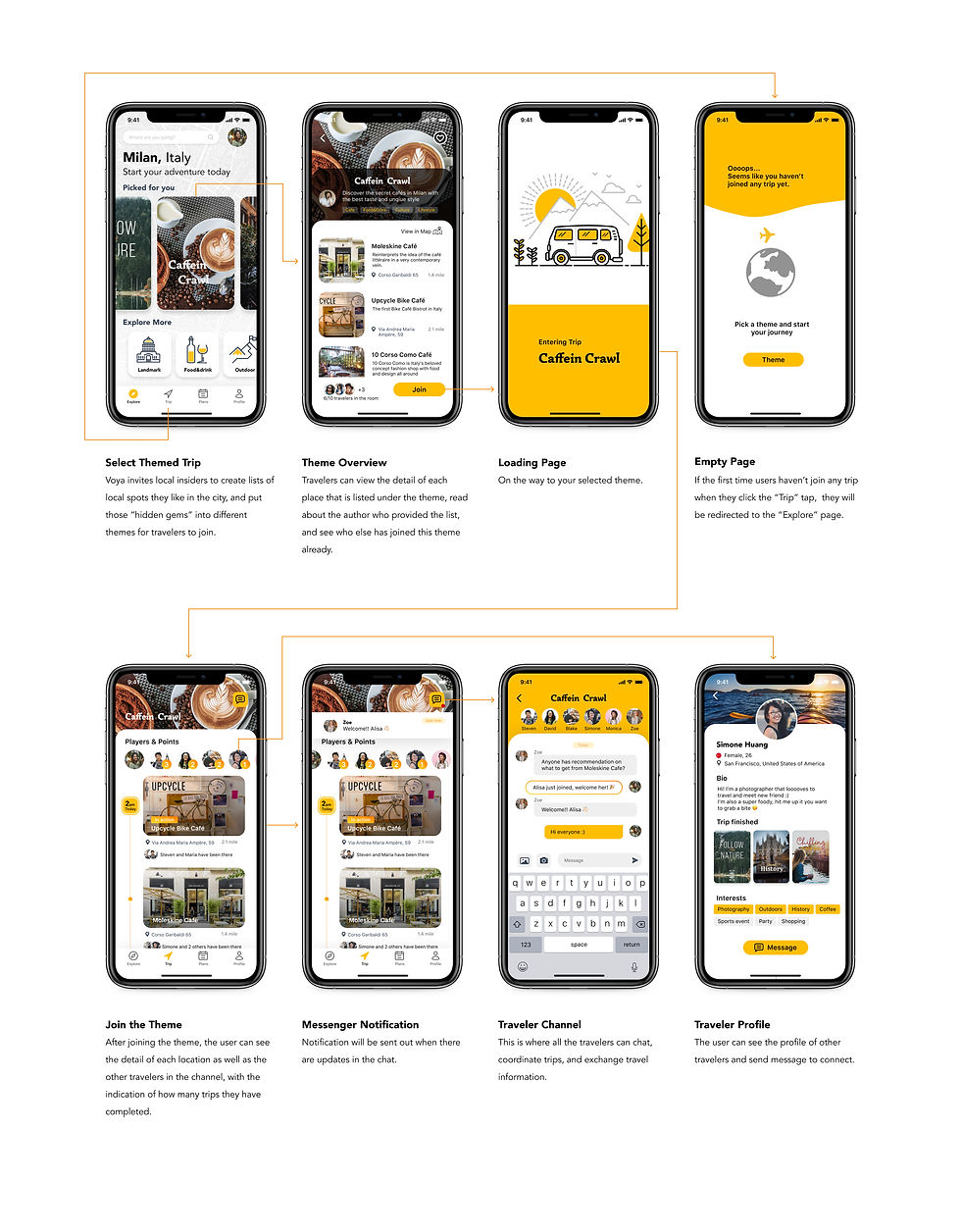
Voya invites local insiders to create lists of spots they like in the city and put them into themes. Many mainstream tourist websites might overlook those places, but in Voya, travelers can read about them as well as the authors who provide their favorite place lists. Based on users’ preferences, Voya recommends trip themes that fit users’ interests.
Mapping out solo travel experience
After synthesizing the interview results, I mapped out the journey of solo travelers throughout their trips. From the map, I can see a pattern of some common pain points and I decided to focus my design around the experience after travelers arrived at the destination.

How does Voya work?
The main traveler flow has two steps: The user needs to select a "Theme" that contains different locations to visit, and make a "Trip" to each location to finish the task and earn points. There are three stakeholders that support this experience:
-
Solo travelers: Explore the city and meet other travelers through Voya.
-
Local insiders or travel experts: Work for Voya and create trustworthy content that can be made into themes for the travelers.
-
Local Business: Through a partnership, local shops provide discounts to Voya customers. In return, Voya helps them attract customers and gain recognition by featuring those businesses, and giving their coupons to travelers as a reward.
System map

Personalized recommendations
Review the lists of places that locals created under different themes. Pick the theme you like.
Meet liked-minded people
Join the Player Channel and chat with other travelers who are interested in the same theme.
Explore together
Team up to explore the hidden gems in the city. Earn points by finishing the tasks.
Earn points for more fun
Exchange points for discounts in local bars - another chance to hang out with the team in real life.
Final concept
A trustworthy platform that provides localized travel insights and encourages solo travelers to build connections naturally through a fun and gamified city exploration.

Lo-fi prototype
I built a low fidelity prototype to demonstrate the flow of each feature and get user fedback early on.


User testing
To validate my concept, I conduct a few in-person user tests and a remote test through Zoom. The testing exposed some issues with the initial idea and I'm very glad that they were pointed out in the early stage.
Most of the problems that the testers have happened after they entered the player channel, and when they started the trip.

“ I was expecting to see other travelers after joining the theme, but I just saw the place list again instead.”
Since the trip preview page has indicated how many players are there in each theme before joining, users expect to see those travelers after they entered the room.
The change:
I added a thumbnail of each player with the points that they got to make people feel more engaging. Users can also click their profile to see their introduction and send direct messages.
I also changed the horizontal layout into vertical, so that users can access the chatbox easier with a simple left slide.
After

Before

“I want to know how many people are going to join me. It might not be efficient to coordinate everything in a group chat.”
This was the biggest challenge I got from the testing. Users expressed that there wasn’t enough companionship if they just hit “Go” and expected others to join them. They also questioned the effectiveness of forming trips through a group chat.
The change:
I added more guidance and structure for people to meet up instead of only relying on travelers to coordinate through a group chat. In the new version, users can either start a trip or join an existing trip that other players have started.
After
Before


“ How am I supposed to type and reply to the status bar?"
Many users got confused with the status bar and thought it was a chatbox. The two input areas are also too scattered and not clear for users to interact smoothly.
The change:
I consolidated "chatbox" and "status update" (send photo & location) into one component and made it just for people on the trip. I also added a standard “show more” icon on the top right corner for users to see destination details and mark reached.
After
Before

Ideation and evaluation
After brainstorming a variety of possible ideas, I analyzed the value of each concept based on user impact and development effort. This helped me settle on a list of final features.

1. Join a themed trip and connect with other travelers
Alisa wants to pick a theme she is interested in exploring and seeing who else is interested in doing the same thing.
2. Go to the listed locations with your team and complete the task.
Alisa saw a trip that starts in the afternoon. She decided to join this trip with three other travelers.

3. Redeem the points for coupons to use in local venues
Alisa has finished two trips now, she decided to redeem the points she earned for coupon, and invites other travelers who have the same coupons to hangout at those local venues.


Connect with like-minded travelers
After entering the selected theme, users can see all the other travelers interested in this topic. Each channel has a maximum of 12 individuals allowed, which creates a relaxed environment for people to chat and socialize.


Turn solo trip into a fun group game
Users can start a trip to each place in the list and invite others to meet up at the destination or on the way. Everyone that joined the trip can chat, update their status, and send location updates within the team until they reach the destination and meet in person. Each player can earn a reward point after they finish the task and complete each trip.
Next Step
-
Validating user flows and prototype through usability testing
-
Creating the Local Insider side of the application
-
Envisioning a sustainable business model